
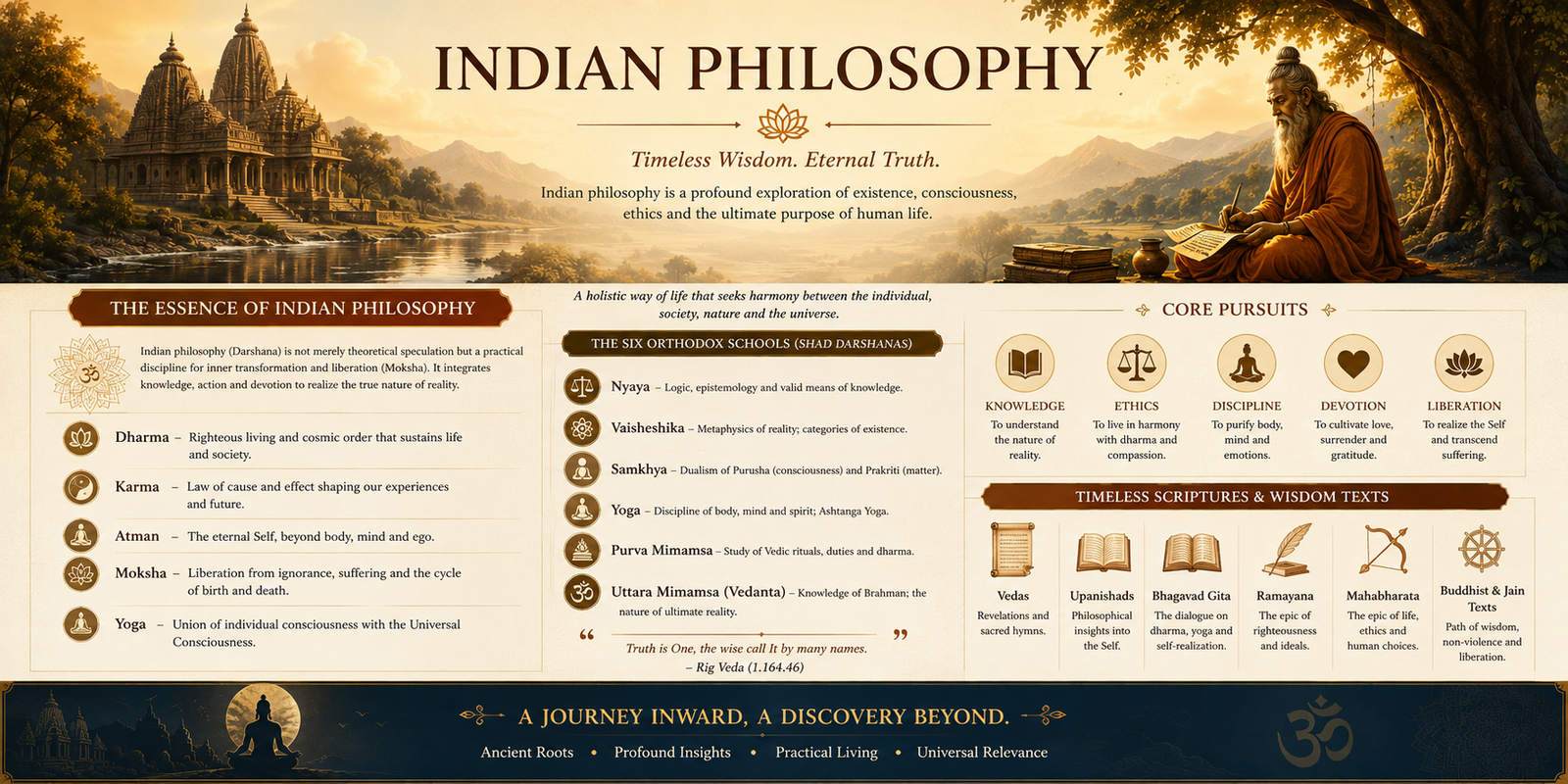
Indian Philosophy,
Indian philosophy represents a diverse and evolving collection of intellectual traditions that have explored questions concerning reality, knowledge, consciousness, ethics, suffering, liberation, and the nature of the self.
The term “Indian philosophy” encompasses many different schools and traditions. They should not be treated as a single, uniform system of thought.
Among the major classical traditions are the six orthodox schools commonly associated with the Vedic intellectual tradition:
- Nyaya
- Vaisheshika
- Samkhya
- Yoga
- Mimamsa
- Vedanta
Indian philosophical thought also includes important non-Vedic traditions such as Buddhism and Jainism, along with numerous other intellectual movements and regional traditions.
Important concepts include dharma, karma, moksha, atman, brahman, ahimsa, pramana, yoga, and dependent origination, among many others.
The meaning of these concepts can vary considerably between philosophical schools. For this reason, PhilosophicalInsights aims to explain them within their respective traditions rather than assigning one universal definition to every concept.
Our objective is to make these philosophical traditions accessible while respecting their complexity.